
Scholarly Impact
Global Impact and SDGs

Organizational and individual research and scientific performance has been shifting over the years, but one of the most important measures is ‘impact’.
You can consider impact from a variety of dimensions. How many ‘top tier journal’ publications in which a scholar has published. For business and management scholars this usually means publishing in UT Dallas Listing, or Financial Times 50, or Australia Business Dean Council (ABDC) A*, or ABS 4*, etc. Many countries and schools have their own journal impact list. In terms of broad indexes there are Web-of-Science and Scopus indexed journals, where scholars aim for Q1 (quarter 1) journals of journals based on impact factor or cite score.
Another measure for individual impact scores derive from citations and H-index. One of the most popular and easily accessible sites with this information is Google Scholar. It has become an academic and scholarly industry standard. I wrote about Schoogling back in 2011 in an Organizations and Natural Environment (Academy of Management Division) blog.
Although very useful to find and access publications, as a performance measurement tool Google Scholar has many shortcomings. To me, it is a rough measure of impact, but like any other measure it is imperfect.
Of course, there are also impact based on the various ranking and evaluation tools such as the ‘Stanford/Elsevier’ top 2% of scholars (which has become its own sub-industry), and Research.com’s ranking of scholars based on discipline, and ScholarGPS which shows global impact/rankings (over past 5 years and lifetime) based on dozens of topics. Each has its own criteria and typically use the same databases.
There are also Highly Cited Researchers (HCR) from the Web of Science, which used to be subtitled “The most influential scientific minds” or something like that.
These examples are generic academic impact based on H-index, number of publications, and citations. There is also more difficult to determine impact such as on policy (see the Sage Policy Profile). Scopus also has various impacts such as Field Weighted Citations to help with normalization (fields differ).
Yes, there are many rankings and impact evaluations—each with its own difficulties. But, what does this have to do with sustainability? Well, this is what motivated me to write this short article.
Sustainability Impact
In doing some ego-surfing—I came across a new Scopus measure that I have not seen on impact. It uses the United Nation’s Sustainable Development Goals (SDGs) to determine how my publications map to the SDGs. There are 17 SDGs.
To get to this impact diagram, you first need to get into Scopus and your institution (or you) needs to subscribe. Search for an author and go to their ‘full profile’. In the full profile (towards the middle of the screen) you will see “Impact”. Click on that tab.
I did this for myself. Figure 1 shows my publication impact on the the SDGs as of the date of writing this article. Figure 1 also shows number of publications and citations over time (you can widen this picture).
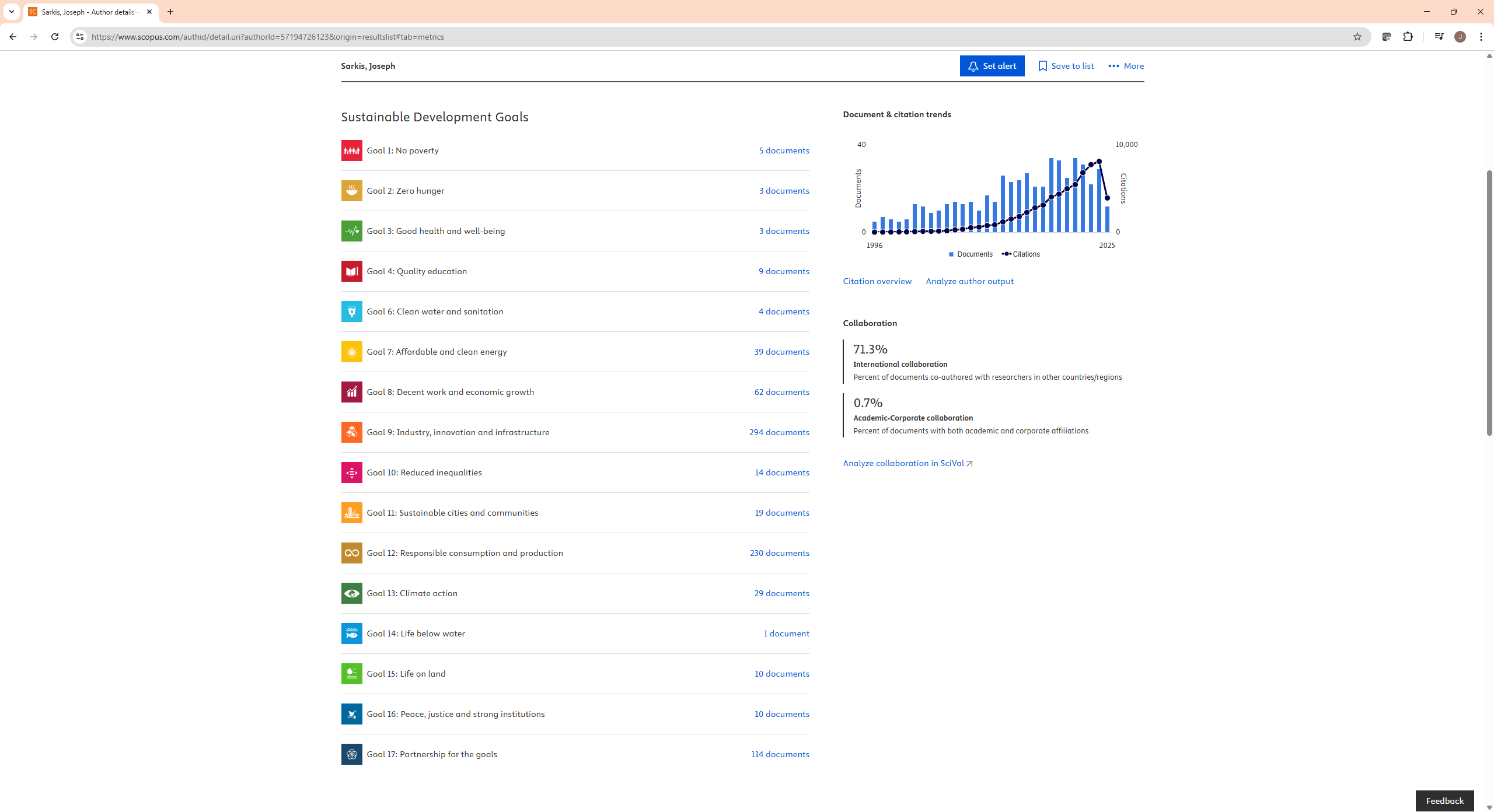
Although there are other metrics available for impact and quality on this site. The SDGs was a recent (October 2024) addition to the Scopus author impact page. They use some machine learning and predictive tools to determine and link papers to the SDGs.
According to Scopus authors can now:
Track and showcase individual researcher contributions to SDGs
Quickly access relevant authors’ documents grouped under each SDG
Assess authors’ societal contributions and impact
Learn more about each SDG
Yes, it can do those things. I will not go into detail on each, they do this. I will just evaluate my impact!
My SDG Impact
So where are my SDG impacts? I have publications that fit 16 of the 17 SDG goals.
The top two goals are: Goal 9 (Industry, Innovation, and Infrastructure) with 294 documents and Goal 12 (Responsible Consumption and Production) with 230 publications. I certainly knew these would fit best.
My publications are least aligned with Goal 5 (Gender Equality) (no publications, only one out of the 17 SDGs) and surprising to me Goal 14 (Life below water). I would have thought that my maritime environmental transportation work would have fit there better (e.g. green ports and green shipping, but none did).
I have thought about including gender equality issues (some of my papers mention consideration of feminist theory as future work). But, I have shied away from it. As a male scholar, I felt hesitant to be a lead author or even a voice of any authority on gender issues (i.e. I shied away from ‘mansplaining’ criticism). Although, I did realize much more work is needed on the topic in my field. In fact, I made an observation about sustainability and gender in academia back in 2014 when I blogged about the “Gender Gap” in sustainability research.
This isn’t the first time I have come across an evaluation of SDGs in my areas of research. My colleague Sherwat Ibrahim and I have an article in the International Journal of Production Research, where we looked over the 60+ year history of the journal and mapped articles to the SDGs. The most underrepresented SDG was SDG 5. Our field of operations and supply chain management is male dominated (about 80 to 90% historically, but changing). This is likely to change.
In my research on various topics, sometimes gender played a role in our analyses with sustainability. Some of my current collaborators wish to look at this issue in more depth and there is more growth. Eventually, I believe I will fill this last SDG with a number of thoughtful research publications.
What does the future hold?
Right now, I believe having this resource can provide a different way for us to evaluate our impact. The publications (and maybe citations) can be tied to the SDGs. Where are my most influential works in terms of the SDGs? Can we get an SDG score for every scholar? Should we be going after SDG impact rather than just citations and general academic impact.
Overall, I think there are some interesting research and practical opportunities. Given that our incentive systems and reputations are based on citations, H-index, quality of publication outlet, etc. Why not SDGs!
Personally, I’m proud to have 16 of the 17 SDGs listed. Of course, how and why they are listed really needs some skepticism. But, at least we have an initial measure and I’m glad to see this.
I can now go back to my personal WPI website and update my SDG connections I have there!
Great viewpoint Joe!! I agree with what you are highlighting and you should be very proud to have 16 of 17 while being authentic to yourself and bringing great impact.